
Bass Guitar Tuning: Standard EADG, 5-String and Drop D
How to tune a 4-string bass to standard E A D G, add the low B on a 5-string, and switch to drop D or half step down, with a tuner app or by ear.
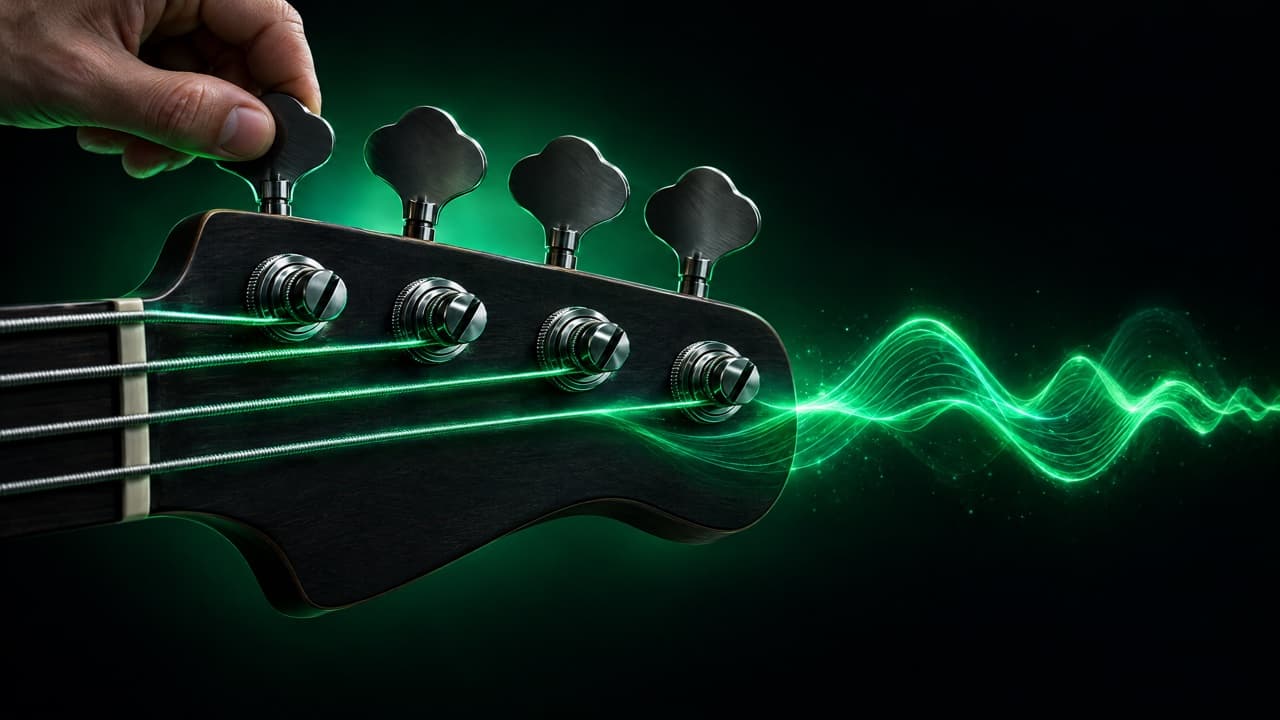
Standard tuning for a four-string bass is E A D G, from the thickest string to the thinnest. Those are the same notes as the four lowest strings of a guitar, one octave lower. A five-string bass adds a low B below the E (B E A D G). Tune with a chromatic or bass tuner: pluck each open string, then tighten or loosen it until the tuner reads the target note in the centre.
Standard tuning notes
| String | Note | Frequency |
|---|---|---|
| 5th (5-string only) | B0 | 30.9 Hz |
| 4th, thickest | E1 | 41.2 Hz |
| 3rd | A1 | 55.0 Hz |
| 2nd | D2 | 73.4 Hz |
| 1st, thinnest | G2 | 98.0 Hz |
The frequencies follow from the A4 = 440 Hz reference in ISO 16. They're low enough that some phone microphones struggle with the B string, which is why the steps below matter.
How to tune a bass step by step
- Open Struno, choose the bass mode (4-string or 5-string), or use chromatic mode.
- Pluck the open E string with your finger, not with a pick near the bridge. A fuller, rounder attack gives the tuner a cleaner fundamental.
- Let the note ring for a second before reading the gauge. The first moment of a low note is full of overtones.
- If the needle sits left of centre, the string is flat: tighten it. Right of centre is sharp: loosen it. Always finish by tuning up to the note.
- Repeat for A, D and G, then go back to E. Bass necks move noticeably when you change string tension.

Tips for the low B and E
- Hold the phone close to the speaker of the amp, or near the neck pickup if you're playing unplugged.
- Use the harmonic at the 12th fret: lightly touch the string above the fret wire and pluck. It's the same note one octave higher, and tuners read it more easily.
- If the reading jumps between two notes, you're probably picking up an overtone. Pluck softer.
Tuning a bass by ear (5th-fret method)
If you have no tuner, tune the E string to a reference (a piano, a keyboard app or another instrument), then:
- Press the E string at the 5th fret: that's A. Tune the open A string to match.
- Press the A string at the 5th fret: that's D. Tune the open D to match.
- Press the D string at the 5th fret: that's G. Tune the open G to match.
On a five-string, the low B at the 5th fret gives E. Harmonics make this easier: the harmonic at the 5th fret of one string matches the harmonic at the 7th fret of the next higher string. When two notes are slightly apart you'll hear a slow "wah-wah" beating; tune until it stops.
Drop D and other bass tunings
- Drop D (D A D G): lower only the E string a whole step to D1. Common in rock and metal. Check it against the open D string: same note, one octave lower.
- Half step down (Eb Ab Db Gb): every string a semitone lower. Used to match guitarists who tune down.
- Drop C (C G C F): a whole step down plus the low string another whole step. Heavier strings help it stay stable.
Tune the guitarist and the bassist to the same reference. If the guitar is in half step down and you're not, nothing will sit right, no matter how well you play.
Why a bass goes out of tune
- New strings stretch for the first days. Retune often, or stretch them gently after installing.
- Temperature and humidity move the neck. Let the instrument settle in the room before tuning.
- Heavy fretting pulls notes sharp. If the open strings are perfect but fretted notes are sharp, play lighter or have the intonation checked.
Once you're in tune, lock in with the drummer. Practising bass lines with a click is the fastest way to tighten your timing, and our metronome guide shows how.
FAQ
Is bass tuning the same as guitar?
The four strings of a standard bass use the same note names as the four lowest guitar strings (E A D G), one octave lower. Bass has no B and E strings on top.
Can I use a guitar tuner for bass?
A chromatic tuner works for any instrument. Guitar-only modes may not include the low B of a five-string bass, so use chromatic or a dedicated bass mode.
Why won't my tuner read the low B string?
At about 31 Hz, the fundamental is near the bottom of what small microphones pick up. Use the 12th-fret harmonic, play through an amp, or move the phone closer.
Keep reading
 Struno••5 min read
How to Tune a Guitar with a Chromatic Tuner: Standard and Drop D
A step-by-step guide to tuning a six-string guitar to standard EADGBE and Drop D with a tuner app, plus the habits that keep it in tune longer.
 Struno••5 min read
Alternate Guitar Tunings: Open G, DADGAD, Half Step Down and Drop C
String-by-string notes for Open G, Open D, DADGAD, half step down and Drop C tunings, how to get there from standard and how to keep your strings safe.
 Struno••6 min read
How to Tune a Ukulele: Standard GCEA, Low G and Baritone DGBE
Learn how to tune a ukulele to standard GCEA with a chromatic tuner, the difference between high G and low G, baritone DGBE tuning and why new strings drift.