
Capo Chart: What Key You're Playing in at Every Fret
A capo chart for guitar: find the real key of C, A, G, E and D chord shapes at frets 1 to 7, and pick the capo fret that matches a song or a singer's range.
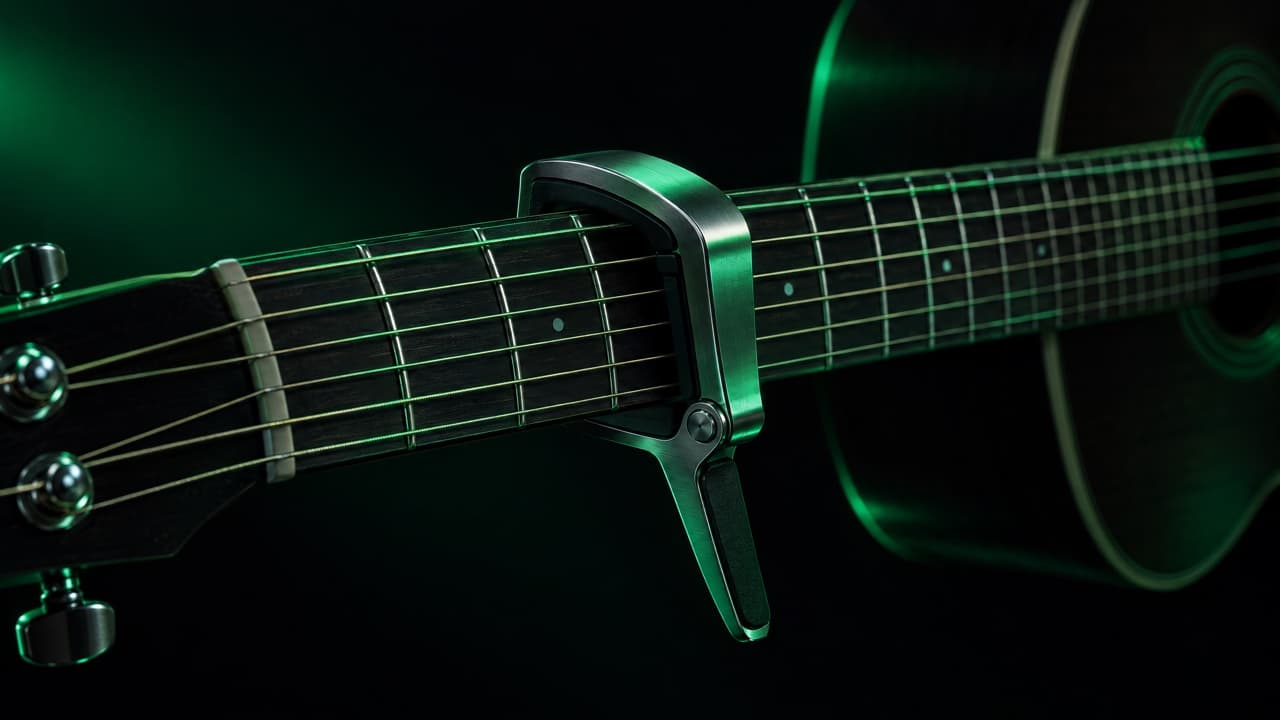
A capo raises every open string by one semitone per fret. So the chord shapes you play keep their names in your head but sound higher: a G shape with the capo on the 2nd fret sounds as A, and a C shape on the 3rd fret sounds as E flat. The chart below shows the real key for the five common open-chord shapes, C, A, G, E and D, from the 1st to the 7th fret.
Capo chart
Find the shape you play in the left column and the capo fret along the top. The cell is the key you actually hear.
| Shape | Capo 1 | Capo 2 | Capo 3 | Capo 4 | Capo 5 | Capo 6 | Capo 7 |
|---|---|---|---|---|---|---|---|
| C | C#/Db | D | D#/Eb | E | F | F#/Gb | G |
| A | A#/Bb | B | C | C#/Db | D | D#/Eb | E |
| G | G#/Ab | A | A#/Bb | B | C | C#/Db | D |
| E | F | F#/Gb | G | G#/Ab | A | A#/Bb | B |
| D | D#/Eb | E | F | F#/Gb | G | G#/Ab | A |
Minor shapes work the same way: an Am shape with the capo on 3 sounds as Cm, an Em shape on 2 sounds as F#m.
How to read it backwards: find the capo for a song
Say a song is in B flat and you don't want to play barre chords:
- Find B flat (A#/Bb) in the chart.
- It appears at A shape capo 1, G shape capo 3 and E shape capo 6.
- Pick the shape that makes the song's chords easiest. In G shapes, a I–IV–V song is G, C and D, all open chords. So: capo 3, play G, C and D shapes.
The same trick moves a song into a singer's range. If the original key is too low, move the capo up and keep the same shapes until the melody sits comfortably.
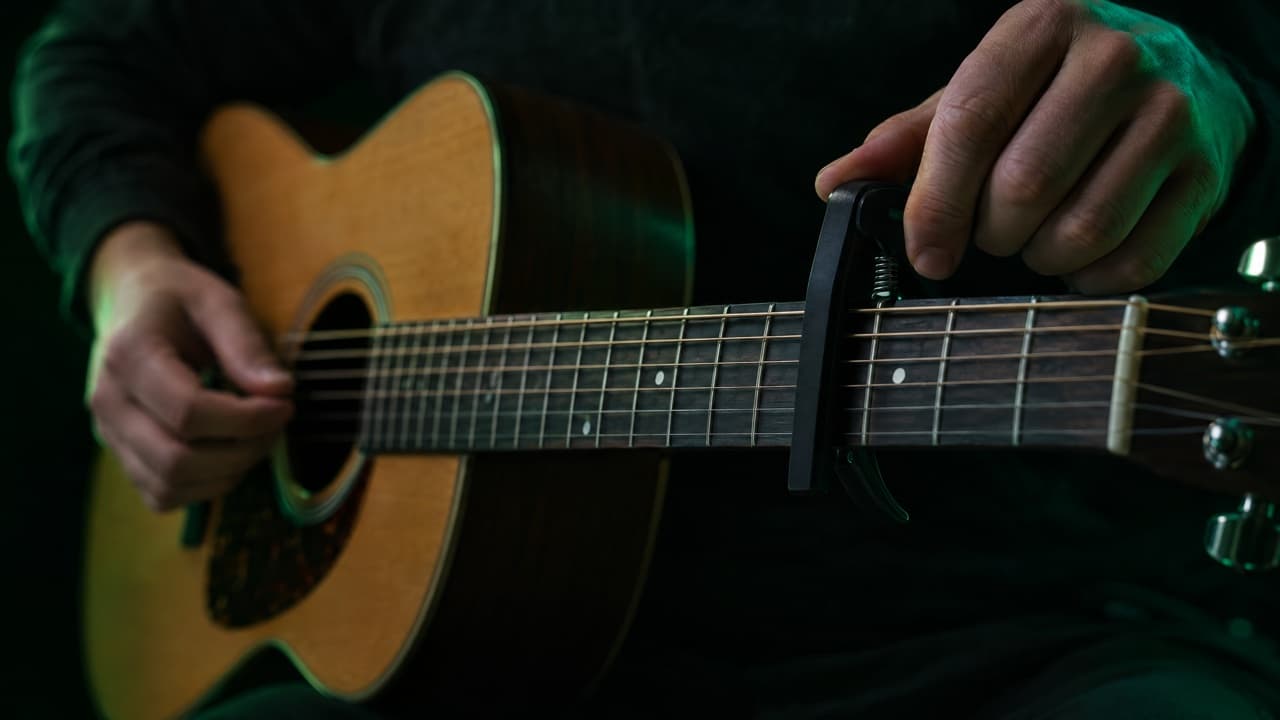
How to put a capo on properly
- Clamp it just behind the fret, close to the fret wire, the same spot where your finger would press.
- Keep it straight across the neck. A tilted capo pulls some strings sharp.
- Use only as much pressure as you need. Too much tension bends the strings sharp; check the tuning after clamping and retune if needed.
- Take it off by sliding it towards the headstock, not by dragging it up the neck over the frets.
Why tabs and chord sheets say "capo 2"
Songwriters often write in open shapes and use a capo to reach the key they sing in. The chord sheet lists the shapes (G, C, D) and adds "capo 2" at the top. If you play those shapes without the capo, you'll be a whole step lower than the recording.
Let the app do the transposing
Struno's chord library supports capo transposition: set the capo fret and see which shapes to play for the key you need, or the real chord names for the shapes you know. Pair it with the tuner after you clamp the capo, because it can pull strings out of tune by a few cents. For practice, the chord library also has common progressions like I–IV–V–I in any key; our guide to the circle of fifths explains why those chords belong together.
FAQ
Does a capo change the key?
Yes. Each fret raises the pitch of every open string by one semitone, so the key goes up by the same amount. The chord shapes and fingerings stay the same.
What key is capo 2 with G chords?
A major. G shapes with the capo on the 2nd fret sound two semitones higher: G becomes A, C becomes D and D becomes E.
Can I use a capo on a bass or ukulele?
Yes, with a capo made for that neck width. The chart works for ukulele shapes too, as long as you read the shape names as they are on the ukulele.
Keep reading
 Struno••4 min read
Circle of Fifths for Guitar: Keys, Chords and Progressions Made Simple
Use the circle of fifths on guitar to find the chords in any key, write I–IV–V and ii–V–I progressions, and read key signatures, with a simple chart.
 Struno••6 min read
How to Practice with a Metronome and Actually Get Faster
A practical method for metronome practice: start slow, raise the tempo a few BPM at a time, use subdivisions and beats 2 and 4, and know when to speed up.
 Struno••5 min read
Pentatonic Scale on Guitar: Minor and Major Box Shapes Explained
Learn the minor pentatonic box on guitar, how the five positions connect, and how the same shape plays major pentatonic and blues. With a fretboard chart.