
Major Scale on Guitar: The Pattern, the Formula and How to Use It
Learn the major scale on guitar: the whole-half step formula, one movable shape for G, A or C major, how to practise it and how it connects to chords.

The major scale is seven notes built with the step pattern whole, whole, half, whole, whole, whole, half. C major is C D E F G A B; G major is G A B C D E F#. On guitar you learn it as one movable shape: put the root on the 6th string, play the pattern below, and slide it to any fret to change key. It's the scale behind most melodies, chords and the circle of fifths.
The formula
A whole step is two frets; a half step is one fret. Starting from any note and following W–W–H–W–W–W–H gives that note's major scale. On a single string it looks like this for G on the 6th string: frets 3, 5, 7, 8, 10, 12, 14, 15. That works, but it's a lot of moving, so guitarists use shapes across several strings.
One movable shape: G major at the 3rd fret
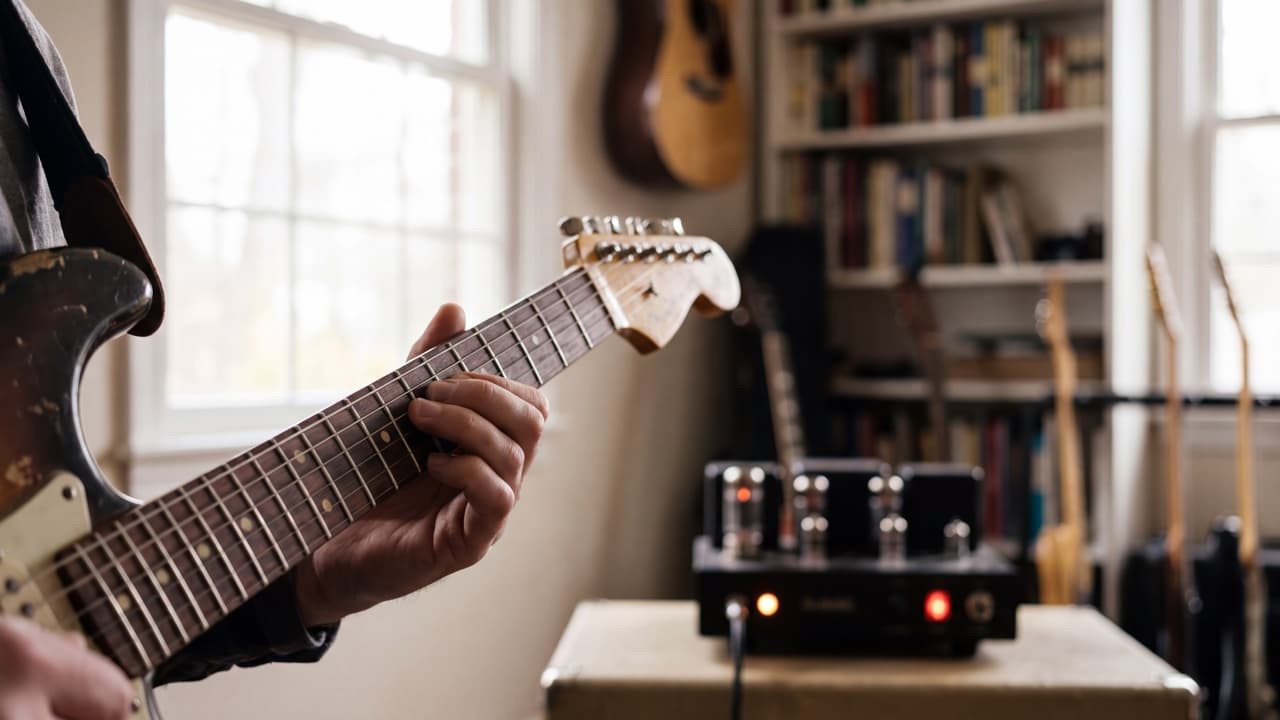
Put your middle finger on the 3rd fret of the low E string (G). Use one finger per fret from the 2nd to the 5th fret.
| String | Frets | Notes |
|---|---|---|
| 6th, low E | 3, 5 | G, A |
| 5th, A | 2, 3, 5 | B, C, D |
| 4th, D | 2, 4, 5 | E, F#, G |
| 3rd, G | 2, 4, 5 | A, B, C |
| 2nd, B | 3, 5 | D, E |
| 1st, high E | 2, 3, 5 | F#, G, A |
The G notes (the roots) are on the 6th string 3rd fret, 4th string 5th fret and 1st string 3rd fret. Start and finish on them.
Change key by moving the shape
The shape is movable: the fret of the root on the 6th string decides the key.
| Key | Root fret on the 6th string |
|---|---|
| F major | 1 |
| G major | 3 |
| A major | 5 |
| B major | 7 |
| C major | 8 |
| D major | 10 |
C major, the "no sharps or flats" scale, is easiest to see here at the 8th fret, or in open position: C (5th string, 3rd fret), D (open 4th), E (4th, 2nd fret), F (4th, 3rd fret), G (open 3rd), A (3rd, 2nd fret), B (open 2nd), C (2nd, 1st fret).
How to practise it
- Play the shape up and down at 60 BPM, one note per click. Say the note names while you play.
- Play it in thirds: G B, A C, B D… This trains your ears for melodies.
- Play it over a drone or a recording in the key, and finish phrases on the root.
- Raise the tempo a few BPM at a time; our metronome practice guide has the method.
Major scale and chords
Stack every other note of the scale and you get its chords: in G major those are G, Am, Bm, C, D, Em and F#dim. That's why songs in G use G, C, D and Em, and why the pentatonic scale (five of these seven notes) fits over them. The same scale started on other notes gives the modes; see our guide to guitar modes.
See it on the fretboard
Struno shows the major scale and 11 other scales and modes on the guitar fretboard in any key, so you can see every position at once instead of counting frets. Its chord library shows the chords of the key, and the progressions (I–IV–V–I, ii–V–I) use exactly the chords this scale produces.
FAQ
What is the formula for a major scale?
Whole, whole, half, whole, whole, whole, half. On guitar: two frets, two frets, one fret, two, two, two, one.
What is the easiest major scale on guitar?
C major in open position, or G major with the shape above. Both use the same pattern of notes; only the starting fret changes.
Is the major scale the same as Ionian?
Yes. Ionian is the name of the major scale when it's discussed as one of the seven modes.
Keep reading
 Struno••5 min read
Pentatonic Scale on Guitar: Minor and Major Box Shapes Explained
Learn the minor pentatonic box on guitar, how the five positions connect, and how the same shape plays major pentatonic and blues. With a fretboard chart.
 Struno••4 min read
Guitar Modes Explained: Dorian, Mixolydian and the Other Five, Simply
The seven modes are the major scale started from different notes. What each mode sounds like, how to play Dorian and Mixolydian on guitar, and when to use them.
 Struno••5 min read
How to Read Guitar Tabs: Lines, Numbers and Symbols Explained
A beginner's guide to reading guitar tablature: what the six lines and the numbers mean, how chords look, and what h, p, b, slashes and x stand for.