
How to Read Guitar Tabs: Lines, Numbers and Symbols Explained
A beginner's guide to reading guitar tablature: what the six lines and the numbers mean, how chords look, and what h, p, b, slashes and x stand for.
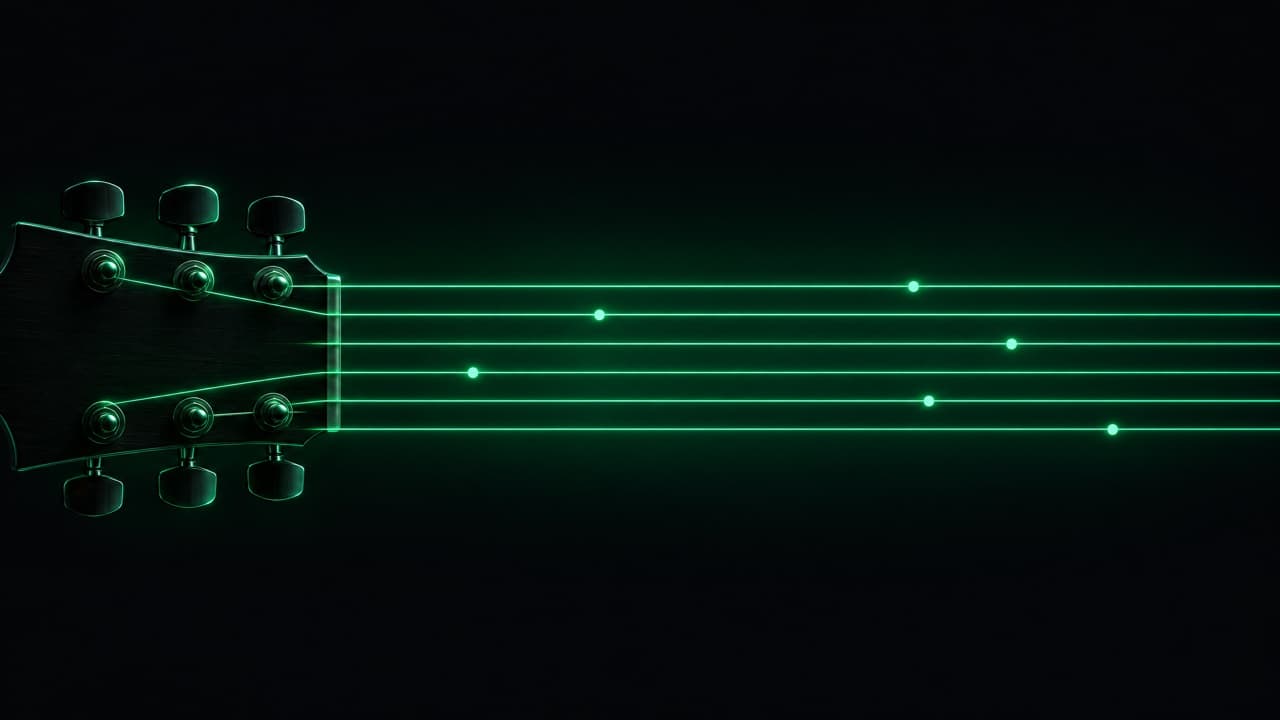
Guitar tab (tablature) shows where to put your fingers instead of which notes to play. It has six horizontal lines, one per string, with the top line being the thinnest string (high E) and the bottom line the thickest (low E). A number on a line is the fret to press on that string; 0 means play the string open. You read it left to right, and numbers stacked on top of each other are played together as a chord.
The six lines
Hold the guitar in your lap and look down at the strings: the string nearest your face is the low E. Tab flips that view so it reads like a page, which confuses almost everyone at first:
| Tab line | String | Standard tuning |
|---|---|---|
| Top | 1st, thinnest | E (high) |
| 2nd | 2nd | B |
| 3rd | 3rd | G |
| 4th | 4th | D |
| 5th | 5th | A |
| Bottom | 6th, thickest | E (low) |
Many tabs label the lines with the string letters on the left. If the letters are different (D A D G B E, for example), the song uses an alternate tuning and you have to retune first. See our guide to alternate guitar tunings.
Numbers are frets
- 0: play the open string.
- 3: press the string just behind the 3rd fret.
- 12: press behind the 12th fret (two-digit numbers are one fret, not two).
Single numbers one after another are a melody or a riff. Numbers in one vertical column are played at the same time, which is how chords appear in tab. An open G chord, for example, is written as 3 on the low E, 2 on the A, 0 on the D, G and B strings, and 3 on the high E, all stacked in one column.
Common tab symbols
| Symbol | Name | What to do |
|---|---|---|
| h | Hammer-on | Pick the first note, then press a higher fret without picking again |
| p | Pull-off | Pick the higher note, then pull the finger off to sound the lower one |
| b | Bend | Push the string sideways to raise the pitch; "7b9" means bend the 7th fret up to the pitch of the 9th |
| r | Release | Let a bent string return to its normal pitch |
| / | Slide up | Slide the finger up the neck to the next fret number |
| \ | Slide down | Slide down the neck |
| ~ | Vibrato | Wiggle the string to make the note waver |
| x | Muted note | Rest the fretting hand on the string and pick a percussive "click" |
| PM | Palm mute | Rest the edge of the picking hand on the strings near the bridge |
| < > | Natural harmonic | Touch the string lightly above the fret, don't press it down |
Symbols vary a little between websites, so check the legend if a tab has one.
What tab doesn't tell you
Plain text tab usually has no rhythm. It tells you which notes come in which order but not how long each one lasts. To fill that gap:
- Listen to the recording while reading, and learn the riff a phrase at a time.
- Look for tabs that include standard notation or rhythm marks above the lines.
- Use the song's tempo. Tap along with the recording in a metronome with tap tempo to find the BPM, then practise the riff slower and build up, as described in our metronome guide.
Bass tabs work the same way
Bass tab has four lines (G D A E from top to bottom on a standard four-string bass), or five with a low B. Numbers and symbols mean the same thing.
Before you play: tune and check the chords
Tabs assume your guitar is in the tuning written at the start, usually standard E A D G B E. If the riff sounds wrong but the frets are right, check the tuning first. Struno has a chromatic tuner for standard and alternate tunings and a chord library with clear diagrams, handy when a tab lists chord names above the lines instead of spelling out every fret. Struno doesn't show tabs or songs itself; use it next to the tab you're reading.
FAQ
Is it better to learn tabs or sheet music?
Tabs are faster to start with because they show fret positions directly. Sheet music shows rhythm precisely and works for any instrument. Many guitarists use tab for what to play and the recording for how it sounds.
Why does the tab sound wrong when I play it?
Usually one of three things: the guitar is out of tune or in a different tuning, a capo is needed (the tab says "capo 2" at the top), or the rhythm is different from the recording.
What does a number in brackets mean?
A note in brackets, like (5), is a ghost note or a note that keeps ringing from before. Play it softly or don't pick it again.
Keep reading
 Struno••5 min read
Pentatonic Scale on Guitar: Minor and Major Box Shapes Explained
Learn the minor pentatonic box on guitar, how the five positions connect, and how the same shape plays major pentatonic and blues. With a fretboard chart.
 Struno••4 min read
Bass Guitar Tuning: Standard EADG, 5-String and Drop D
How to tune a 4-string bass to standard E A D G, add the low B on a 5-string, and switch to drop D or half step down, with a tuner app or by ear.
 Struno••4 min read
Capo Chart: What Key You're Playing in at Every Fret
A capo chart for guitar: find the real key of C, A, G, E and D chord shapes at frets 1 to 7, and pick the capo fret that matches a song or a singer's range.