
Power Chords on Guitar: Shapes, How to Play Them and Muting
Power chords are a root and a fifth, the two-note shapes behind rock and punk. Learn the 6th- and 5th-string shapes, one-finger drop D chords and muting.
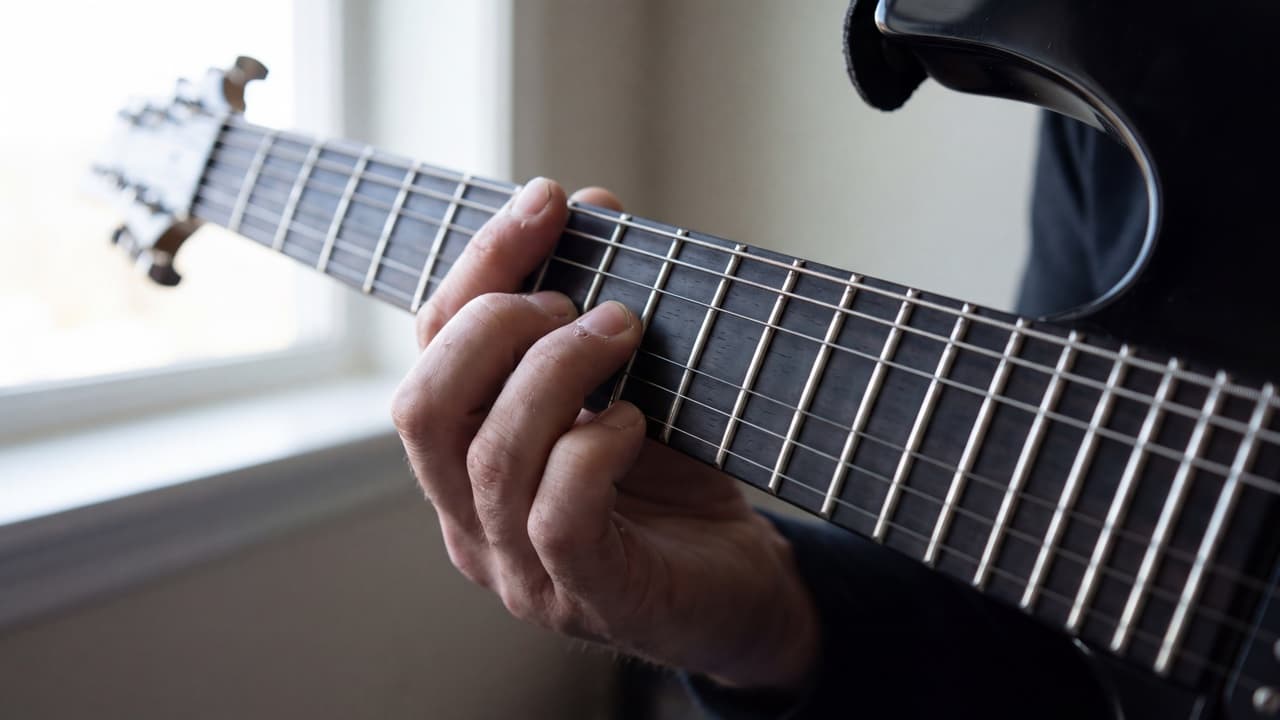
A power chord is two notes, the root and the fifth, often with the root doubled an octave higher. It's neither major nor minor, which is why it sounds huge with distortion and fits almost any rock song. It's written with a 5: G5, A5, C5. You play it with one movable shape on the 6th or 5th string, and slide it up and down the neck to change chords.
The 6th-string shape
Put your index finger on the root on the low E string, your ring finger two frets higher on the A string, and your pinky on the same fret on the D string.
| String | G5 (root at 3rd fret) | A5 (root at 5th fret) |
|---|---|---|
| 6th, low E | 3 (index) | 5 |
| 5th, A | 5 (ring) | 7 |
| 4th, D | 5 (pinky) | 7 |
Only those three strings ring. The 4th-string note is the octave; leave it off for a two-note version.
The 5th-string shape
The same shape, moved over one string: root on the A string.
| String | C5 (root at 3rd fret) | D5 (root at 5th fret) |
|---|---|---|
| 5th, A | 3 (index) | 5 |
| 4th, D | 5 (ring) | 7 |
| 3rd, G | 5 (pinky) | 7 |
Between the two shapes you can play any power chord within a few frets, which makes fast riffs easier.
Finding the right fret
On the 6th string: F at 1, G at 3, A at 5, B at 7, C at 8, D at 10, E at 12 (or open). On the 5th string: B at 2, C at 3, D at 5, E at 7, F at 8, G at 10, A at 12 (or open). Open E5 and A5 use the open string as the root.
Muting: the secret to a clean power chord

- Fretting hand: let the underside of your index finger lightly touch the strings below the chord so they can't ring.
- Picking hand: aim only at the chord strings; if the low E rings during a 5th-string chord, rest your thumb or pick tip on it.
- Palm muting: rest the edge of your picking hand on the strings right at the bridge for the chugging rock sound.
One-finger power chords in drop D
Tune the low E down to D (drop D) and the bottom three strings form a power chord when you lay one finger flat across them. D5 is all three open; barring the 5th fret gives G5. Our guide on how to tune a guitar shows how to tune to drop D, and alternate guitar tunings covers drop C.
Practice ideas
- Alternate G5 and C5 (6th-string and 5th-string shape at the 3rd fret): the move behind countless riffs.
- Play E5 – G5 – A5 with steady eighth notes and palm muting.
- Use a metronome and change on the beat; our metronome guide helps you build speed.
Look up any power chord
Struno's chord library includes power chords (the "5" chords) in every key, along with major, minor, 7th and suspended chords, so you can check a shape or see which notes it contains.
FAQ
Why are they called power chords?
They sound powerful through a distorted amp: with only a root and a fifth, distortion doesn't turn them muddy the way full major or minor chords can.
Are power chords major or minor?
Neither. They have no third, so they fit over major and minor songs alike.
Can I play power chords on an acoustic guitar?
Yes, though they sound thinner without distortion. Full chords usually work better on acoustic.
Keep reading

 Struno••4 min read
Circle of Fifths for Guitar: Keys, Chords and Progressions Made Simple
Use the circle of fifths on guitar to find the chords in any key, write I–IV–V and ii–V–I progressions, and read key signatures, with a simple chart.
 Struno••6 min read
How to Practice with a Metronome and Actually Get Faster
A practical method for metronome practice: start slow, raise the tempo a few BPM at a time, use subdivisions and beats 2 and 4, and know when to speed up.
 Struno••4 min read
Ukulele Chords for Beginners: The 10 Chords That Play Most Songs
The ten ukulele chords beginners learn first, C, Am, F, G, Em, Dm, D, A, C7 and G7, with finger positions, easy chord changes and song progressions.