
How to Practice with a Metronome and Actually Get Faster
A practical method for metronome practice: start slow, raise the tempo a few BPM at a time, use subdivisions and beats 2 and 4, and know when to speed up.
Most players who say a metronome doesn't help them are using it the same way: set it to the song's tempo and try to hang on. That mostly trains you to play fast and sloppy. Used properly, a metronome shows you exactly where your playing breaks down and lets you move that point up a little at a time, which is how you actually get faster.
What BPM means
Metronome speed is measured in BPM, beats per minute. At 60 BPM you hear one click per second; at 120 BPM, two per second. In most songs written in 4/4, each click is one quarter note, so you count "1, 2, 3, 4" across four clicks.
Before you start, make sure your instrument is in tune. Practicing against a click while slightly out of tune trains your ear in the wrong direction. If you need a refresher, see how to tune a guitar or how to tune a ukulele.
Step 1: find your clean tempo
Pick a short passage: one riff, one chord change, or one or two bars of a tricky part. Short sections let you repeat them many times and give you a clear target.
Set the metronome slow enough that you can play the passage perfectly three times in a row: right notes, relaxed hands, every note landing on the click. That's your starting tempo. If you're unsure where to start, try half of the song's tempo. It will probably feel too easy, which is the point.
Step 2: increase by a few BPM
Once the passage is clean at your starting tempo, raise the metronome by a few BPM and play it again. Keep going in small steps.
- Play the passage cleanly three times in a row.
- Raise the tempo by a few BPM.
- Repeat until mistakes start to creep in.
- Drop back a few BPM below that point and play it cleanly again before you stop.
That last step matters: ending on clean repetitions reinforces the version you want to keep, not the rushed one. Write down your top clean tempo at the end of each session, and the next day start a little below it and climb again.
Let the tempo trainer do the climbing
Stopping to change the tempo breaks your focus. Struno includes a Tempo Trainer that gradually increases the BPM for you, so you can keep playing while the tempo rises. Its metronome covers 40 to 240 BPM, which is enough room to start very slow and still reach fast targets.
Step 3: use subdivisions
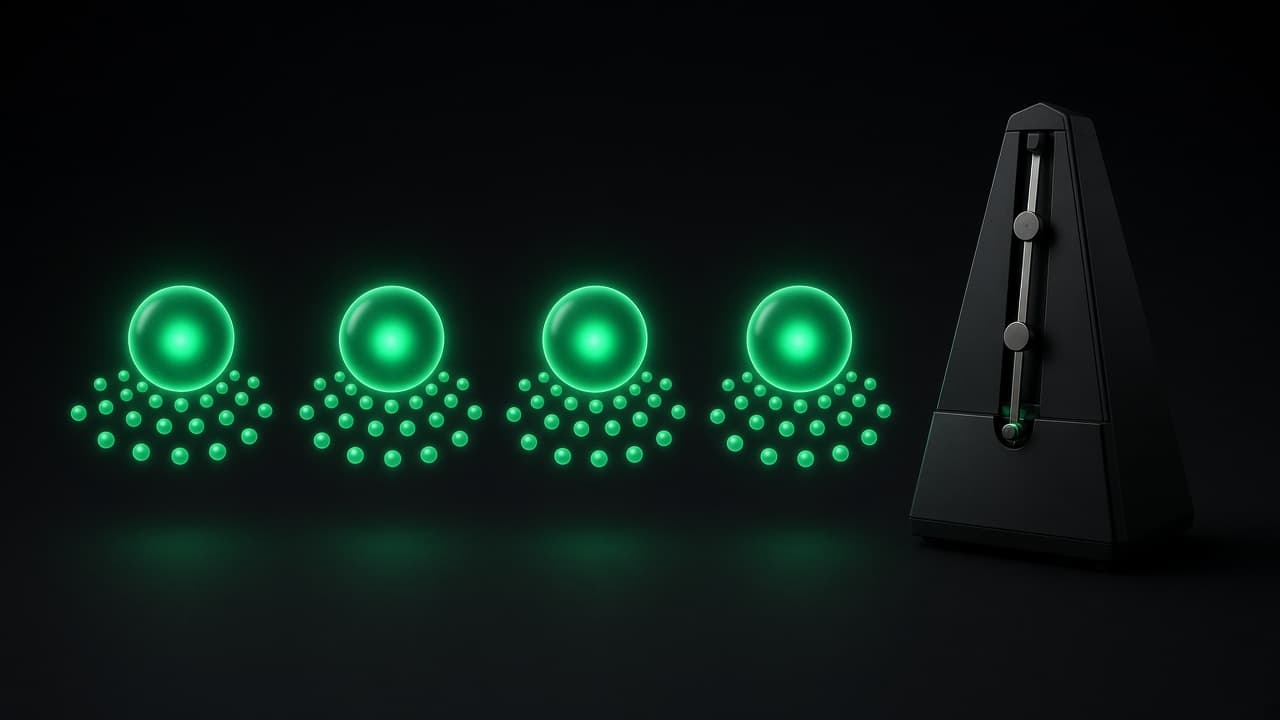
A subdivision splits each beat into smaller, even parts: two eighth notes, three triplets, or four sixteenth notes per beat. Turning subdivisions on fills the space between clicks with quieter ticks.
Subdivisions help in two situations:
- Slow tempos. At 50 or 60 BPM the gaps between clicks are long, and most people rush to fill them. Hearing the subdivisions keeps you even.
- Fast note patterns. If you're working on sixteenth-note picking or strumming, set the subdivision so every note you play has a tick to land on. Once that's solid, turn subdivisions off and keep the same feel with only the main beat.
Step 4: match the time signature
A time signature tells you how the beats are grouped into bars. The top number says how many notes are in each bar, and the bottom number says which note value is being counted: 4 for quarter notes, 8 for eighth notes (time signature basics).
- 4/4: four quarter-note beats per bar. Most pop, rock and folk.
- 3/4: three beats per bar. Waltzes and many ballads.
- 6/8: six eighth notes per bar, usually felt as two beats of three.
Set the metronome to the time signature of the piece you're practicing so the clicks follow the shape of the bar. It's also worth choosing a click sound that cuts through your instrument. Struno has six sounds, and a sharper click is easier to hear over a loud guitar or drums.
Step 5: put the click on beats 2 and 4
Once you can play with the click on every beat, make it harder by giving the metronome less to do. In a lot of pop, rock, funk and jazz, the backbeat falls on beats 2 and 4. You can practice that feel directly:
- Halve the tempo. For a song at 100 BPM in 4/4, set the metronome to 50 BPM.
- Count so that each click is "2" or "4". You supply beats 1 and 3 yourself, in the silence.
- Play the passage. If you drift, the click will land in the wrong place and you'll hear it immediately.
This builds internal time: you stop leaning on the metronome and start keeping the pulse yourself. For a bigger challenge at faster tempos, go down to one click per bar. A song at 160 BPM in 4/4 with the metronome at 40 BPM gives you one click on every beat 1.
Find a song's tempo with tap tempo
To practice a song you know from a recording, you need its tempo. Use tap tempo: play the track, tap along with the beat for a few bars, and the metronome calculates the BPM.
Tap the main pulse you'd clap along to. If you tap every eighth note by accident, you'll get roughly double the real tempo. Once you have the number, set your practice tempo well below it and climb using the method above. If you don't have a recording to tap along to, the genre presets give you a quick starting point.
Signs you're ready to speed up
Move up only when all of these are true:
- You play the passage cleanly several times in a row, not once out of five tries.
- Your notes land on the click, not slightly ahead (rushing) or behind (dragging).
- Your hands, forearms and shoulders stay relaxed, and you're breathing normally.
- You can count out loud or look away from your hands without falling apart.
- You can play it with the click on beats 2 and 4.
Slow down if you notice tension, if mistakes keep landing in the same spot, or if the passage gets worse with each repetition. That last one usually means you're tired, and a short break helps more than another ten tries.
Common metronome mistakes
- Practicing only at the target tempo. You rehearse the mistakes along with the notes.
- Jumping too far at once. Big tempo jumps undo the control you just built.
- Playing around the click. If you can't hear the metronome while you play, you're either too loud or not listening. Turn it up or pick a sharper sound.
- Never turning it off. The goal is steady time without the click. Finish sessions by playing along with the recording or on your own.
A good session doesn't need to be long. A few focused minutes on one passage, with a note of where you ended, beats an hour of playing the whole song at full speed.
Keep reading
 Struno••3 min read
How to Tune a Guitar with a Chromatic Tuner: Standard and Drop D
A step-by-step guide to tuning a six-string guitar to standard EADGBE and Drop D with a tuner app, plus the habits that keep it in tune longer.
 Struno••6 min read
How to Tune a Ukulele: Standard GCEA, Low G and Baritone DGBE
Learn how to tune a ukulele to standard GCEA with a chromatic tuner, the difference between high G and low G, baritone DGBE tuning and why new strings drift.

 Bear Bite••3 min read
How to Keep a Food Diary Habit Past Week Two
Most people stop logging meals within a couple of weeks. Here's how to make calorie tracking small enough to survive busy days, travel and the occasional pizza night.