
Alternate Guitar Tunings: Open G, DADGAD, Half Step Down and Drop C
String-by-string notes for Open G, Open D, DADGAD, half step down and Drop C tunings, how to get there from standard and how to keep your strings safe.

Alternate tunings change the notes of the open strings so that chords, drones or a heavier sound come more easily. The most common ones are Open G (D G D G B D), Open D (D A D F# A D), DADGAD, half step down (Eb Ab Db Gb Bb Eb) and Drop C (C G C F A D). Each is reached from standard tuning by lowering a few strings; use a chromatic tuner and tune string by string, lowest first.
Tunings at a glance
Strings are listed from the 6th (thickest) to the 1st (thinnest). Bold notes differ from standard E A D G B E.
| Tuning | 6 | 5 | 4 | 3 | 2 | 1 | Changes from standard |
|---|---|---|---|---|---|---|---|
| Standard | E | A | D | G | B | E | — |
| Drop D | D | A | D | G | B | E | 6th down a whole step |
| Open G | D | G | D | G | B | D | 6th, 5th and 1st down a whole step |
| Open D | D | A | D | F# | A | D | 6th, 2nd, 1st down a whole step; 3rd down a semitone |
| DADGAD | D | A | D | G | A | D | 6th, 2nd and 1st down a whole step |
| Half step down | Eb | Ab | Db | Gb | Bb | Eb | Every string down a semitone |
| Drop C | C | G | C | F | A | D | Every string down a whole step, 6th down two |
Drop D has its own section in our guitar tuning guide.
Open G
Strum all six strings without fretting and you get a G major chord. Barring one fret across all strings gives a major chord at any position (5th fret: C, 7th fret: D), which makes Open G the classic tuning for slide guitar and for the ringing, riff-based rhythm parts of blues and rock. Many players leave the 6th string out entirely and play five strings.
Open D
Open strings sound a D major chord. It's darker and deeper than Open G and popular for fingerstyle and slide. The 3rd string has to come down only a semitone to F#; that's the one people most often get wrong.
DADGAD
Not major or minor: the open strings make a suspended chord (Dsus4), so the tuning works for both major and minor songs and leaves room for drones. It's widely used in Celtic and acoustic fingerstyle music. Compared with Open D, only the 3rd string differs (G instead of F#).
Half step down (Eb tuning)
Every string goes down one semitone, so all your usual shapes still work but sound a semitone lower. Players use it to sound heavier, to make bends easier on slightly looser strings, or to match a singer. A chromatic tuner will show flats or sharps (Eb or D#); they're the same pitches.
Drop C
Drop D moved down a whole step: power chords on the bottom three strings with one finger, in a lower and heavier register. On standard-gauge strings it can feel floppy; heavier strings (or a setup for them) keep it in tune and stop the low string from buzzing.
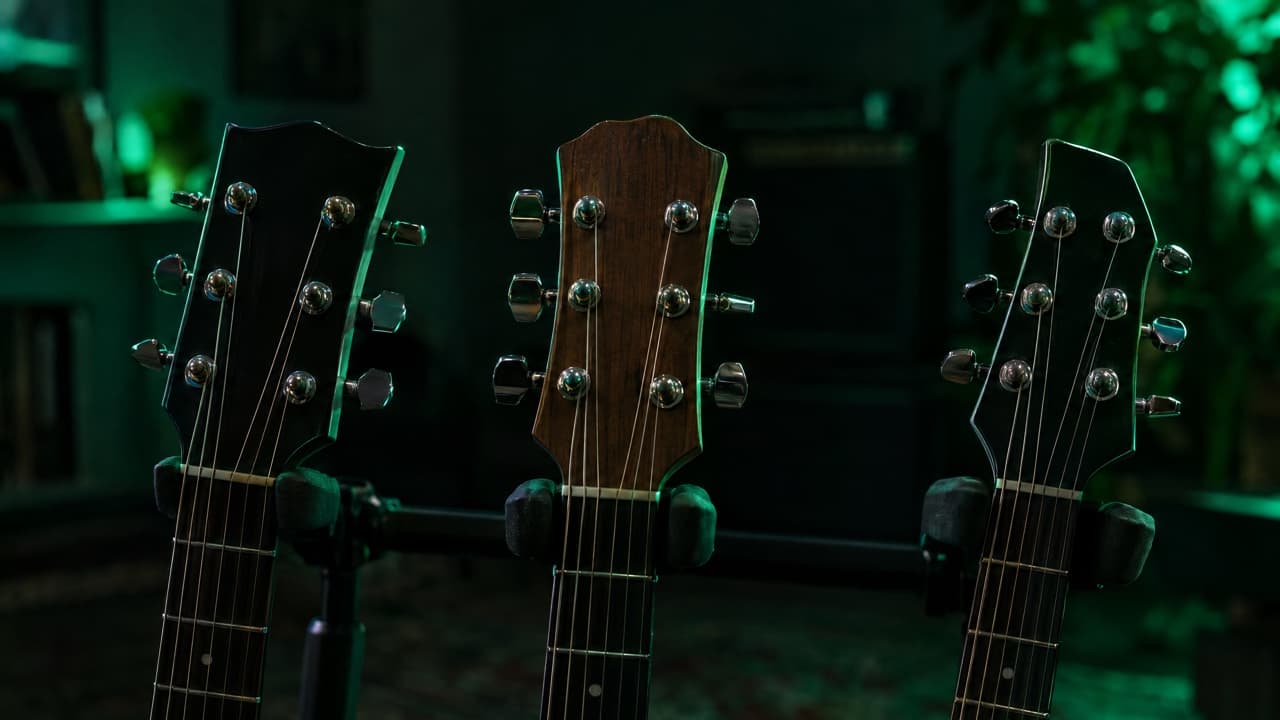
How to retune safely
- Lowering is safe, raising is not. Every tuning here only lowers strings. Tuning a string more than a whole step above standard adds tension that can snap it or stress the neck.
- Tune from the lowest string to the highest, then make a second pass. Changing several strings moves the neck, and the first ones drift.
- Approach each note from below: drop slightly under the target and come back up, so the string holds pitch.
- Expect a few minutes of settling. Strings that just went down a step keep creeping for a while; check again before you record.
Use a chromatic tuner for alternate tunings. In Struno, chromatic mode shows the note name and how many cents you are off, so you can hit F# or Eb as easily as E. The chord library and the 12 scales on the fretboard are drawn for standard tuning, so use them for theory and your ears for open-tuning shapes.
Which tuning should you try first?
- Want slide or big ringing chords: Open G.
- Fingerstyle, Celtic or ambient: DADGAD.
- Heavier rock riffs: Drop D, then Drop C.
- Same shapes, lower pitch: half step down.
FAQ
Is it bad for the guitar to change tunings often?
Lowering strings is not harmful. Frequent large changes can make the neck relief shift slightly, and very low tunings may need heavier strings to stay in tune, but occasional changes are normal.
Do I need to change the strings for Drop C?
Not necessarily, but heavier strings help low tunings stay in tune and stop the low string from flopping or buzzing.
What is the easiest open tuning for beginners?
Open G: strumming all strings gives a G chord and one finger across a fret gives other major chords.
Keep reading
 Struno••4 min read
Bass Guitar Tuning: Standard EADG, 5-String and Drop D
How to tune a 4-string bass to standard E A D G, add the low B on a 5-string, and switch to drop D or half step down, with a tuner app or by ear.
 Struno••5 min read
How to Tune a Guitar with a Chromatic Tuner: Standard and Drop D
A step-by-step guide to tuning a six-string guitar to standard EADGBE and Drop D with a tuner app, plus the habits that keep it in tune longer.
 Struno••5 min read
Pentatonic Scale on Guitar: Minor and Major Box Shapes Explained
Learn the minor pentatonic box on guitar, how the five positions connect, and how the same shape plays major pentatonic and blues. With a fretboard chart.