
Banjo Tuning: Open G (gDGBD) for 5-String, Plus 4-String and Tenor
How to tune a 5-string banjo to open G (gDGBD), what the short fifth string does, and the standard tunings for 4-string, tenor and Irish tenor banjos.

The standard tuning for a 5-string banjo is open G: g D G B D, written from the 5th string to the 1st. The 5th string is the short one that starts at the fifth fret and is tuned to a high G (G4); the other four are D3, G3, B3 and D4. Strum all five open strings and you hear a G major chord. Four-string banjos use different tunings: C G D A for tenor and G D A E for Irish tenor.
5-string banjo: open G
| String | Note | Frequency | Notes |
|---|---|---|---|
| 5th (short) | G4 | 392 Hz | Highest pitch, though it sits next to the thickest string |
| 4th | D3 | 147 Hz | The lowest note on the banjo |
| 3rd | G3 | 196 Hz | One octave below the 5th string |
| 2nd | B3 | 247 Hz | The major third of the G chord |
| 1st | D4 | 294 Hz | One octave above the 4th string |
Lower-case "g" in "gDGBD" marks the high short string. Deering Banjos, one of the largest US banjo makers, lists the same notes. The frequencies follow from the A4 = 440 Hz reference in ISO 16.
How to tune a banjo step by step
- Open Struno and choose the banjo, which is set to open G, or use chromatic mode.
- Start with the 4th string (D3), the lowest. Pick it, let it ring and turn the peg until the gauge sits in the centre.
- Tune the 3rd (G3), 2nd (B3) and 1st (D4) the same way.
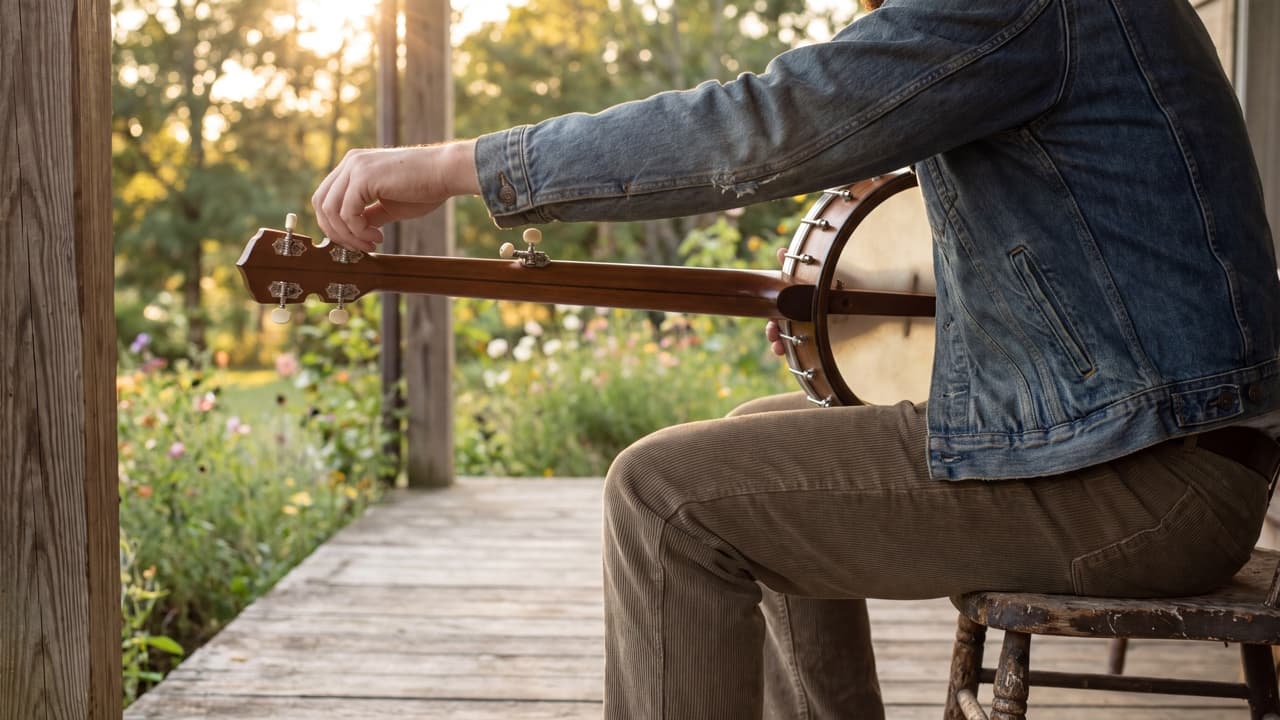
- Tune the short 5th string last, to G4. Its peg is on the side of the neck and often geared differently, so turn it in small steps.
- Do a second pass. A banjo head and bridge move slightly as string tension changes.
Check by ear
- The 4th string at the 5th fret is G: it should match the open 3rd string.
- The 3rd string at the 4th fret is B: match the open 2nd.
- The 2nd string at the 3rd fret is D: match the open 1st.
- The 1st string at the 5th fret is G4: match the open 5th string.
Other 5-string tunings
- Double C (gCGCD): the 4th string goes down a whole step to C and the 2nd up a semitone to C. Common in old-time music.
- G modal / "sawmill" (gDGCD): the 2nd string goes up a semitone to C. Gives a modal, drone-heavy sound.
- Open D (f#DF#AD): for songs in D without a capo.
Many banjo players use a capo for the long strings and a spike or a capo for the 5th string instead of retuning.
4-string banjo tunings
| Banjo | Tuning (4th → 1st) | Used for |
|---|---|---|
| Tenor | C G D A | Jazz, Dixieland |
| Irish tenor | G D A E | Irish traditional music (an octave below a mandolin or fiddle) |
| Plectrum | C G B D | Jazz, like a 5-string without the short string |
| Chicago | D G B E | Guitarists: same as the top four guitar strings |
Sweetwater lists C G D A as the standard 4-string tuning. Struno's banjo mode is set up for the 5-string open G; for a 4-string, use chromatic mode and tune to the table.
Chords in open G
Because the open strings already form G, many first songs need only three shapes: G (all open), C and D7. Struno's chord library includes banjo chords, so you can look up shapes in any key and see the notes on each string. If you also play guitar, our guide to alternate guitar tunings covers open G on guitar, a close relative of the banjo sound.
Why banjos go out of tune
- The head: a loose head lets the bridge sink and pulls everything flat. Tightening a banjo head is a setup job; if tuning won't hold, have it checked.
- The bridge moves: banjo bridges are held in place only by string pressure. If it slides, intonation goes off.
- New strings stretch: retune often for the first days.
FAQ
Why is the fifth string on a banjo short?
It's a drone string tuned to high G. It starts at the fifth fret so its open note sits above the rest and rings through the rolls of bluegrass and clawhammer playing.
Can I tune a banjo with a guitar tuner?
Yes, with a chromatic tuner. Guitar-only modes look for guitar notes, so use chromatic or a banjo mode.
What is the easiest banjo tuning for beginners?
Open G on a 5-string: the open strings make a G chord, and most beginner methods are written for it.
Keep reading

 Struno••3 min read
12-String Guitar Tuning: Octave Pairs, Standard and D Tuning
How a 12-string guitar is tuned: six pairs in standard E A D G B E, octave strings on the lower four pairs, unison on the top two, and why many tune down.
 Struno••3 min read
7-String Guitar Tuning: Standard B Tuning, Drop A and How to Tune
Standard 7-string guitar tuning is B E A D G B E: a low B below the usual six. How to tune it, drop A for heavier riffs, and tips for the thick low string.
 Struno••4 min read
Bass Guitar Tuning: Standard EADG, 5-String and Drop D
How to tune a 4-string bass to standard E A D G, add the low B on a 5-string, and switch to drop D or half step down, with a tuner app or by ear.