
How to Change Guitar Strings: Acoustic and Electric, Step by Step
Change acoustic or electric guitar strings step by step: remove the old set, fit bridge pins or thread through the body, wind the posts, stretch and tune.

To change guitar strings: loosen and remove the old strings, fit the new string at the bridge (with a bridge pin on most acoustics, threaded through the bridge or body on electrics), pull it to the tuning post, wind two or three neat wraps downward, then stretch the string and tune it. Change them when they sound dull, look discoloured, feel rough or won't stay in tune.
What you need
- A new set of the right gauge for your guitar (acoustic and electric sets are different).
- A string winder (optional but saves time) and wire cutters.
- A tuner. Your phone is enough: new strings need retuning several times.
Step by step
- Loosen each string until it's slack. On an acoustic, push the bridge pins up from inside the soundhole or lift them carefully with the slot of a string winder.
- Remove the old strings. Changing one at a time keeps tension on the neck and helps you copy how each was wound; removing all at once lets you clean the fretboard.
- Fit the new string at the bridge.
- Acoustic: put the ball end in the bridge hole and push the pin in, with the pin's groove facing the string. Pull the string gently while pressing the pin so the ball seats against the bridge plate.
- Electric: thread the string through the bridge or through the back of the body, depending on the guitar.
- Pull it to the tuning post. Leave enough slack for two to three wraps on the wound strings and three to four on the plain ones: a common trick is to pull the string past its post by about the distance to the next post, then bend it at the hole.
- Wind downward, so each wrap sits below the last; this increases the break angle at the nut and helps tuning stability. Turn the peg so the string winds toward the centre of the headstock.
- Cut the excess only after the string is near pitch.
- Stretch and tune, see below.
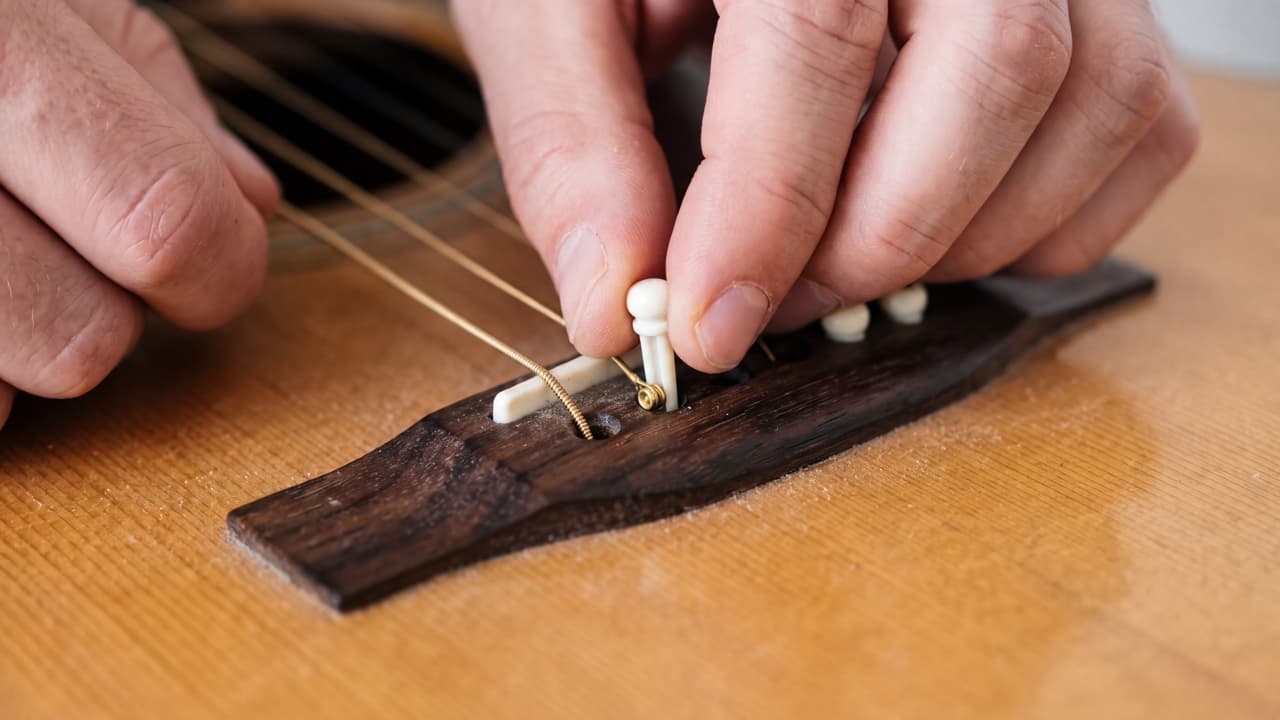
Stretch new strings, then tune again
New strings stretch for days and slowly go flat. To speed it up, tune a string to pitch, gently pull it away from the fretboard along its length a few times, and retune. Repeat two or three times per string. Then tune the whole guitar and play; expect to retune often for the first day. Our guide on how to tune a guitar covers the routine; a chromatic tuner like the one in Struno shows exactly how flat each new string has drifted.
How often to change strings
There's no fixed schedule: it depends on how much you play, your hands and the climate. Typical signs it's time:
- The tone sounds dull, without the bright "zing" of new strings.
- The strings look dark, rusty or feel rough under your fingers.
- The guitar won't stay in tune, or chords sound out of tune high up the neck even when the open strings are right.
Players who perform or play daily often change strings every few weeks; occasional players every few months.
Common mistakes
- Too many wraps: they can slip and make tuning unstable. Two to four is enough.
- Bridge pin not seated: the string slides up as you tighten. Push the pin down and pull the string until the ball catches.
- Wrong direction on the post: the string ends up crossing the others. Wind toward the inside of the headstock.
- Tuning way above pitch: check the note on the tuner before you tighten; the thinnest strings break easily if you overshoot.
FAQ
Should I change all guitar strings at once?
Yes, as a set: old and new strings sound different. You can still replace them one by one in the same session.
Why does my new string keep going out of tune?
It's still stretching. Stretch it gently and retune a few times; it settles within a day or two of playing.
Do acoustic and electric strings differ?
Yes. Electric strings are made for magnetic pickups and are usually lighter; acoustic strings are usually bronze or phosphor bronze. Use the type made for your guitar.
Keep reading

 Struno••3 min read
12-String Guitar Tuning: Octave Pairs, Standard and D Tuning
How a 12-string guitar is tuned: six pairs in standard E A D G B E, octave strings on the lower four pairs, unison on the top two, and why many tune down.
 Struno••4 min read
Major Scale on Guitar: The Pattern, the Formula and How to Use It
Learn the major scale on guitar: the whole-half step formula, one movable shape for G, A or C major, how to practise it and how it connects to chords.
 Struno••4 min read
Guitar Modes Explained: Dorian, Mixolydian and the Other Five, Simply
The seven modes are the major scale started from different notes. What each mode sounds like, how to play Dorian and Mixolydian on guitar, and when to use them.