
Circle of Fifths for Guitar: Keys, Chords and Progressions Made Simple
Use the circle of fifths on guitar to find the chords in any key, write I–IV–V and ii–V–I progressions, and read key signatures, with a simple chart.
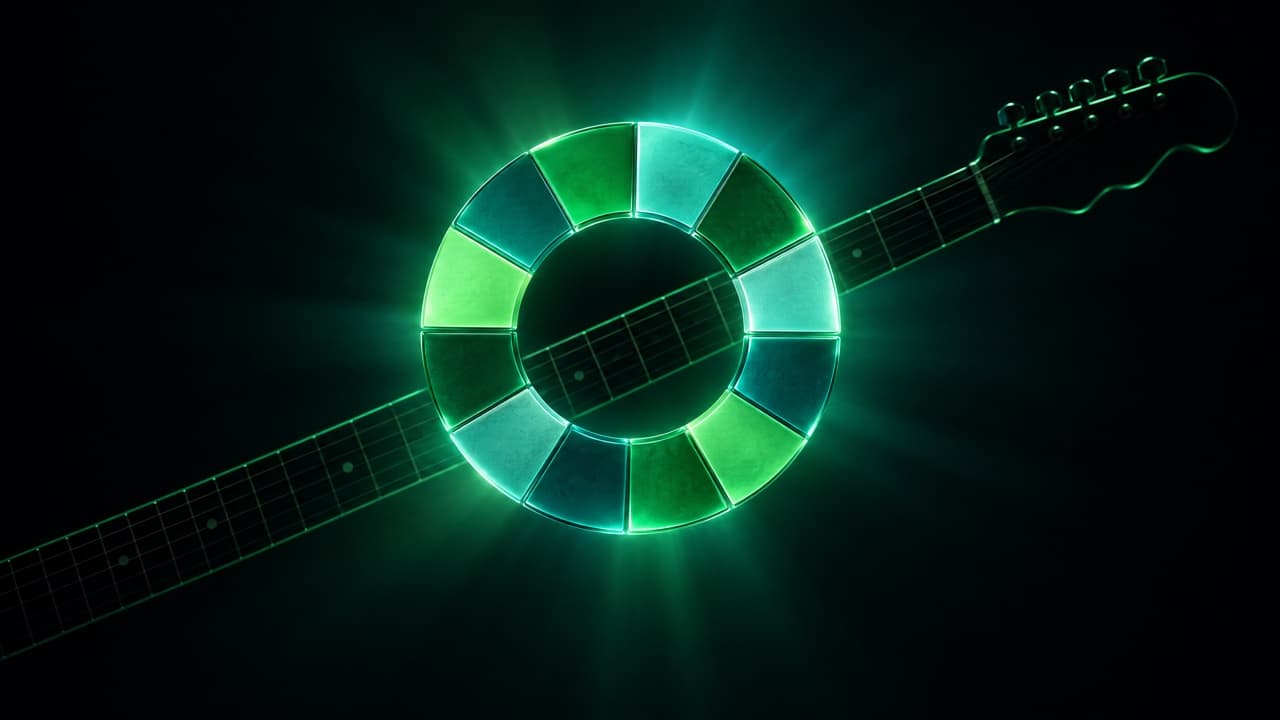
The circle of fifths arranges the 12 major keys so that each one is a perfect fifth (seven semitones) above the one before it: C G D A E B F# Db Ab Eb Bb F, then back to C. For guitarists it answers one practical question fast: which chords belong together. The key you're in and its two neighbours on the circle are your I, IV and V chords; their relative minors are ii, iii and vi.
The circle as a table
Going clockwise adds one sharp to the key signature; going counter-clockwise adds one flat.
| Major key | Relative minor | Sharps or flats |
|---|---|---|
| C | Am | none |
| G | Em | 1 sharp |
| D | Bm | 2 sharps |
| A | F#m | 3 sharps |
| E | C#m | 4 sharps |
| B | G#m | 5 sharps |
| F# / Gb | D#m / Ebm | 6 sharps or 6 flats |
| Db | Bbm | 5 flats |
| Ab | Fm | 4 flats |
| Eb | Cm | 3 flats |
| Bb | Gm | 2 flats |
| F | Dm | 1 flat |
A relative minor uses the same notes as its major key, starting from a different home note. On guitar it's three frets below the major root: A minor is three frets below C.
Find the chords in any key
Pick a key on the circle. Then:
- The key itself is the I chord.
- The neighbour clockwise is V.
- The neighbour counter-clockwise is IV.
- The relative minors of those three are vi, iii and ii.
In the key of G: I = G, V = D, IV = C, vi = Em, iii = Bm, ii = Am. Those six chords cover most pop, rock and folk songs in G. (The seventh chord, the diminished vii, F#dim, is used much less often.)

Progressions you can build from it
- I–IV–V–I (G C D G): the backbone of rock and roll, country and blues.
- I–V–vi–IV (G D Em C): the most common pop progression of the last decades.
- ii–V–I (Am D G): the core of jazz harmony. Notice that each chord moves one step counter-clockwise around the circle; that pull towards the next fifth is what makes it resolve.
- 12-bar blues: four bars of I, two of IV, two of I, then V, IV, I and V.
Why it matters on guitar
- Choosing a key for open chords. Keys near the top of the circle (C, G, D, A, E) use the most open strings. Further around, use a capo: our capo chart shows which shapes give Bb or Eb without barre chords.
- Transposing. Moving a song from G to A means moving the whole I–IV–V group two steps clockwise around the circle: G C D becomes A D E.
- Changing key in a song. Neighbouring keys share six of seven notes, so modulating one step around the circle sounds smooth; jumping across it sounds dramatic.
- Improvising. Over a progression in G, the G major scale (or E minor pentatonic) fits every chord. Our guide to the pentatonic scale shows the shapes.
Practise it with chords and scales
Struno has a chord library with ready-made progressions, including I–IV–V–I, ii–V–I and the 12-bar blues: pick a key and practise the changes straight away. Its 12 scales and modes are drawn on the fretboard in any key, so you can see how the scale for a key lines up with its chords.
FAQ
What is the circle of fifths used for?
It shows how keys relate: their key signatures, which chords belong to each key, relative minors and which keys are close enough for smooth key changes.
How do I memorise the circle of fifths?
Learn the order of sharps with a phrase like "Father Charles Goes Down And Ends Battle" (F C G D A E B). Each new sharp's key is a fifth above the last. The flats are the same phrase backwards: B E A D G C F.
Is it the same as the circle of fourths?
Yes, read in the opposite direction. Counter-clockwise, each key is a fourth above the previous one, which is the direction ii–V–I moves.
Keep reading
 Struno••4 min read
Capo Chart: What Key You're Playing in at Every Fret
A capo chart for guitar: find the real key of C, A, G, E and D chord shapes at frets 1 to 7, and pick the capo fret that matches a song or a singer's range.
 Struno••5 min read
Pentatonic Scale on Guitar: Minor and Major Box Shapes Explained
Learn the minor pentatonic box on guitar, how the five positions connect, and how the same shape plays major pentatonic and blues. With a fretboard chart.
 Struno••5 min read
How to Read Guitar Tabs: Lines, Numbers and Symbols Explained
A beginner's guide to reading guitar tablature: what the six lines and the numbers mean, how chords look, and what h, p, b, slashes and x stand for.