
Pentatonic Scale on Guitar: Minor and Major Box Shapes Explained
Learn the minor pentatonic box on guitar, how the five positions connect, and how the same shape plays major pentatonic and blues. With a fretboard chart.
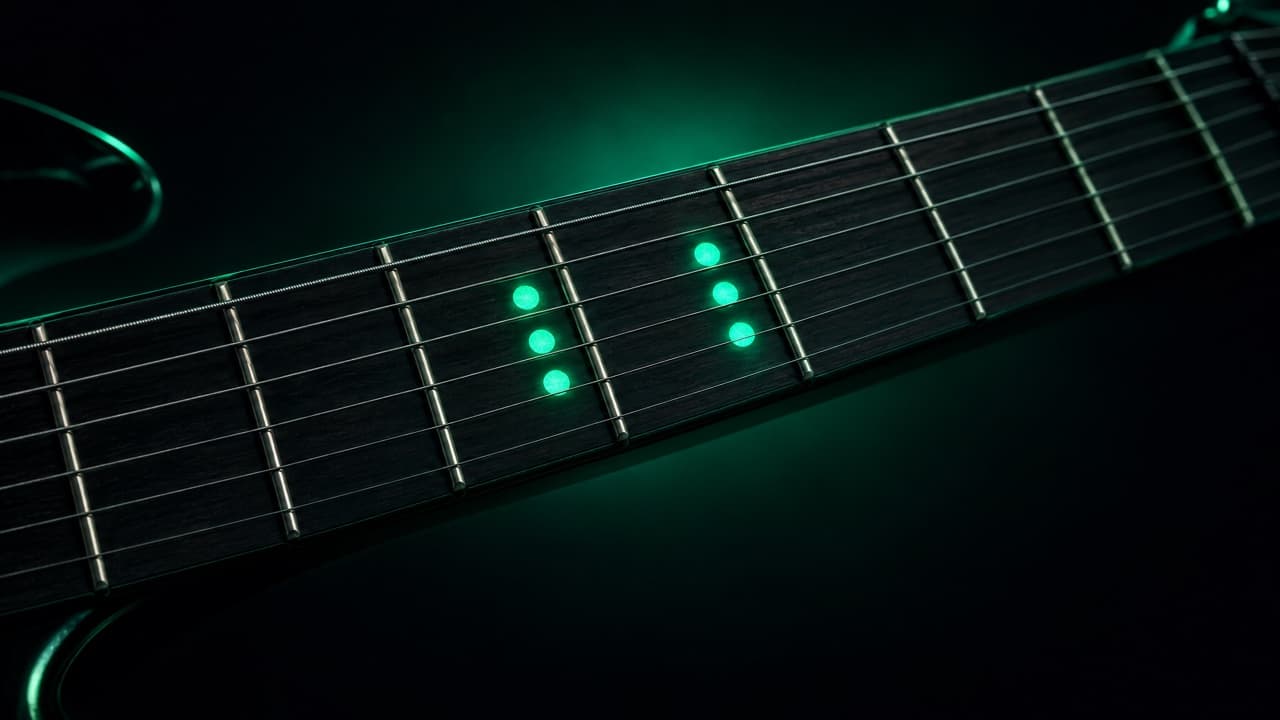
The pentatonic scale is a five-note scale, and on guitar it's usually learned as one "box" shape that fits under four fingers. The minor pentatonic in A uses the notes A C D E G, starts with the first finger on the 5th fret of the low E string, and works over almost any rock, blues or pop song in A minor. Learn that one box first; the other four positions and the major pentatonic are the same notes moved around the neck.
What makes a scale pentatonic
A major or natural minor scale has seven notes. The pentatonic drops the two notes that create the most tension against the chords under them. In A minor those are B and F. What's left is a scale with no "wrong" notes over the basic chords of the key, which is why it's the first scale most guitarists learn for soloing.
- Minor pentatonic: root, minor 3rd, 4th, 5th, minor 7th. In A: A C D E G.
- Major pentatonic: root, 2nd, 3rd, 5th, 6th. In C: C D E G A.
Notice that A minor pentatonic and C major pentatonic contain exactly the same five notes. They are relatives, like A minor and C major. That one fact saves you from learning a second set of shapes.
The first box: A minor pentatonic at the 5th fret
Put your first finger on the 5th fret and play two notes on every string, low E to high E. Use the first finger for the 5th fret, the third finger for the 7th and the fourth (or third) finger for the 8th.
| String | Notes (fret) | Note names |
|---|---|---|
| 6th, low E | 5, 8 | A, C |
| 5th, A | 5, 7 | D, E |
| 4th, D | 5, 7 | G, A |
| 3rd, G | 5, 7 | C, D |
| 2nd, B | 5, 8 | E, G |
| 1st, high E | 5, 8 | A, C |
The roots (A) are on the 6th string at the 5th fret, the 4th string at the 7th fret and the 1st string at the 5th fret. Start and end your phrases on those notes and the scale will sound "finished" even before you know why.

How to practise the box
- Play it up and down slowly, one note per click of the metronome at 60 BPM. Every note should ring cleanly before you go faster.
- Raise the tempo by a few BPM at a time once you can play it three times in a row without a mistake. Our metronome practice guide explains the method.
- Play it in groups of three notes (A C D, C D E, D E G…) so your fingers stop memorising one direction only.
- Put on a backing track or a drone in A and improvise using only the box. Bend the 7th-fret note on the G string up a whole step and you're already playing blues.
The five positions
The box above is position 1. The same five notes repeat all over the neck, and each neighbouring group of them forms another box. In A minor the positions start at roughly these frets:
| Position | Starts around fret | Lowest note on the 6th string |
|---|---|---|
| 1 | 5 | A |
| 2 | 8 | C |
| 3 | 10 | D |
| 4 | 12 | E |
| 5 | 15 (or 3) | G |
Each box shares its right-hand notes with the next box's left-hand notes, so they lock together like puzzle pieces. Learn positions 1 and 2 first and slide between them; the rest come faster once you see that pattern.
Same shape, different key
All pentatonic shapes are movable. Slide the box so your first finger sits on the root you want on the 6th string:
- G minor pentatonic: 3rd fret
- A minor pentatonic: 5th fret
- C minor pentatonic: 8th fret
- E minor pentatonic: 12th fret (or open strings plus the 3rd fret)
To play major pentatonic, use the box of its relative minor: for C major, play A minor pentatonic. Or keep the key and move the minor box three frets lower: A major pentatonic is the minor box starting at the 2nd fret.
Add one note and it's the blues scale
The blues scale is the minor pentatonic plus the flat 5th, the "blue note". In A that's E flat. In the first box you can reach it at the 6th fret of the A string and the 8th fret of the G string. Use it as a passing note between D and E rather than a note to land on.
See the scale on the fretboard
Diagrams are easier to remember when you can see every position at once. Struno shows 12 scales and modes, including minor and major pentatonic and blues, directly on the fretboard in any key, so you can check where the next box starts without counting frets. Keep the guitar in tune while you practise: bends and slides expose a flat string much faster than chords do, and our guitar tuning guide covers the routine.
FAQ
Is the pentatonic scale good for beginners?
Yes. It has five notes, two per string in the first box, and none of them clash with the basic chords of the key. It's the fastest route from playing chords to playing melodies and solos.
What's the difference between minor and major pentatonic?
They use the same shapes with a different note treated as home. A minor pentatonic and C major pentatonic share all five notes; which one you hear depends on the chords underneath and the note you resolve to.
How long does it take to learn all five positions?
Most players can play the first box from memory in a week of short daily practice. Connecting all five usually takes a few months, because the hard part is improvising across them, not memorising them.
Keep reading
 Struno••5 min read
How to Read Guitar Tabs: Lines, Numbers and Symbols Explained
A beginner's guide to reading guitar tablature: what the six lines and the numbers mean, how chords look, and what h, p, b, slashes and x stand for.
 Struno••4 min read
Circle of Fifths for Guitar: Keys, Chords and Progressions Made Simple
Use the circle of fifths on guitar to find the chords in any key, write I–IV–V and ii–V–I progressions, and read key signatures, with a simple chart.
 Struno••4 min read
Bass Guitar Tuning: Standard EADG, 5-String and Drop D
How to tune a 4-string bass to standard E A D G, add the low B on a 5-string, and switch to drop D or half step down, with a tuner app or by ear.